The Future of RAG: Beyond Simple Retrieval
When I first implemented a RAG pipeline, I thought I had solved the "LLM knowledge problem" for good. Embed your documents, store the vectors, retrieve the top-k chunks, inject them into the prompt — done. It felt elegant. It felt complete.
It wasn't.
What I discovered — and what I want to walk you through today — is that naive RAG is not a destination. It is a starting point. The systems that are winning in production, the ones that actually earn user trust, are built on a fundamentally different set of ideas: reasoning before retrieval, verification after generation, and architecture that adapts to the complexity of the question.
In this article, I want to share with you everything I have learned about where RAG is heading — technically, architecturally, and strategically. Whether you are building your first RAG prototype or scaling a production knowledge system, I believe this will reframe how you think about the problem.
1. What Is RAG — And Why Should You Care?
Let me establish a clear foundation before we move into advanced territory.
Retrieval-Augmented Generation (RAG) is an architectural pattern that connects a large language model to an external knowledge source — typically a vector database — at inference time. Instead of relying solely on knowledge compressed into model weights during training, the system retrieves relevant documents and provides them as context for the model to reason over before generating a response.
The original RAG paper from Meta AI (Lewis et al., 2020) demonstrated something important: parametric memory (what the model knows) and non-parametric memory (what the model can look up) are far more powerful in combination than either is alone.
💡 A note I want you to keep in mind throughout this article: RAG does not replace fine-tuning. They are complementary tools. Fine-tuning shapes how a model reasons; RAG expands what it knows at the moment of inference.
Here is what a basic RAG pipeline looks like at a conceptual level:
This looks clean on paper. And for simple, narrow use cases — FAQ bots, single-document Q&A — it works adequately. But the moment you push it toward real enterprise workloads, the cracks appear fast.
2. The Honest Truth About Naive RAG
I want to be direct with you here, because I think the AI community tends to undersell how significantly naive RAG fails in production.
The failure modes cluster into two categories: retrieval failures (the wrong information comes in) and generation failures (the model does something wrong with the right information). Both are serious. Both are preventable.
When I look at the teams I have seen struggle with RAG, the pattern is almost always the same: they implemented a naive pipeline, saw 70–75% accuracy, assumed that was inherent to the technology, and started compromising on the product. The reality is that naive RAG is a baseline, not a ceiling. Advanced techniques routinely push that number above 90% on the same datasets.
Let me show you what those techniques look like.
3. Advanced RAG: The Techniques Worth Knowing
3.1 Hybrid Search — Dense + Sparse Retrieval
This is, in my opinion, the single highest-ROI improvement you can make to any RAG system. Pure vector (dense) search fails on exact keyword matches — product codes, names, error messages, technical identifiers. BM25 (sparse search) excels precisely there. Combining them with Reciprocal Rank Fusion (RRF) gives you the best of both retrieval paradigms.
Here is a clean, production-ready implementation:
3.2 Semantic Chunking
I want you to think carefully about what fixed-size chunking actually does to your documents. A 512-token window does not know — and does not care — that it just cut through the middle of a definition, a code example, or a table row. It destroys context with mechanical indifference.
Semantic chunking respects the logical structure of your content. It measures the embedding similarity between consecutive sentences and splits only when that similarity drops below a threshold — which is a reliable signal of a topic boundary. The result is chunks that hold together as coherent units of thought.
For most frameworks, LangChain's SemanticChunker or LlamaIndex's SemanticSplitterNodeParser are ready-to-use implementations.
3.3 HyDE — Hypothetical Document Embeddings
This technique, introduced by Gao et al. in 2022, genuinely surprised me the first time I tested it. The idea is counterintuitive: instead of embedding the user's question and searching for documents that match it, you ask the LLM to generate a hypothetical answer first, then embed and retrieve documents similar to that answer.
Why does this work? Because the semantic gap between a short, terse query and a long, rich document is large. A hypothetical answer is linguistically much closer to an actual document — same vocabulary, same structure, same density of information.
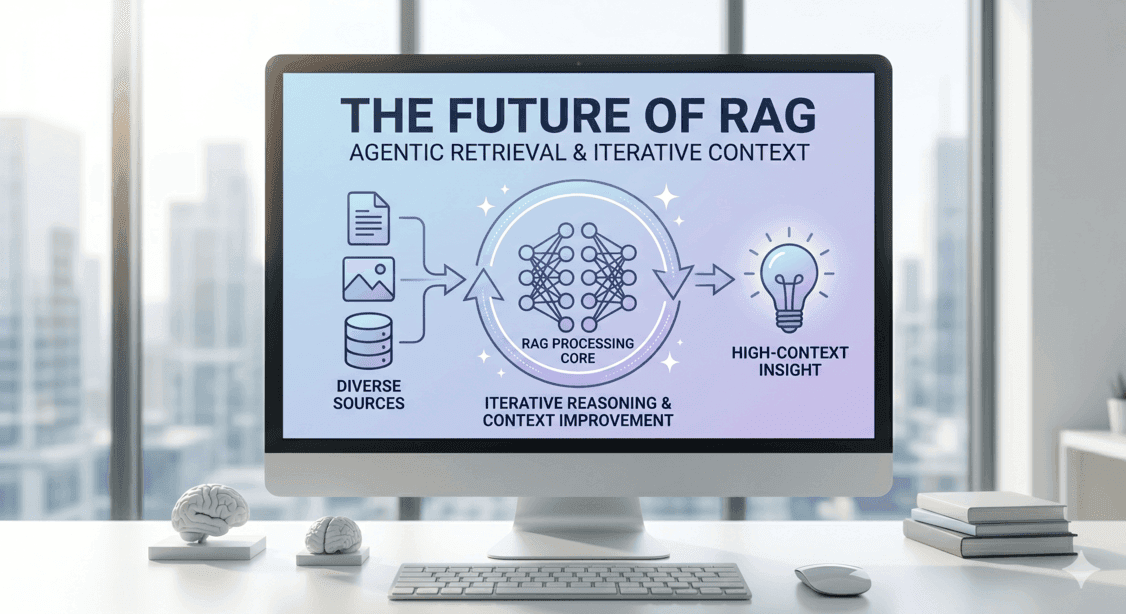
4. Agentic RAG — The Architecture That Changes Everything
This is the area I am most excited to share with you, because it represents a fundamental rethinking of what a RAG system can be.
Standard RAG is passive: the system retrieves once, the model generates once, and the pipeline terminates. There is no opportunity to recognize that the retrieval was insufficient, to ask a follow-up search, or to verify whether the answer is actually grounded.
Agentic RAG changes this completely. The language model is no longer a passive consumer of retrieved context — it becomes an active agent that controls the retrieval process. It decides what to search for, evaluates what it finds, determines whether it has enough evidence, and iterates until it does.
Here is what a full agentic RAG implementation looks like using the Anthropic tool use API:
4.1 Self-RAG — Teaching Models to Know What They Don't Know
I want to draw your attention to a particularly elegant variant: Self-RAG (Asai et al., 2023). This approach trains the model to emit reflection tokens at inference time — special markers that encode judgments like:
- "Do I need to retrieve anything for this?"
- "Is this retrieved passage actually relevant?"
- "Does my generated answer faithfully reflect the evidence?" This is epistemically honest AI. Rather than always retrieving (which wastes resources and introduces noise) or never questioning its output (which produces hallucinations), a Self-RAG model dynamically decides. For latency-sensitive and cost-sensitive applications, this is significant.
5. Graph RAG — When Relationships Matter More Than Chunks
Let me introduce you to what I consider the most intellectually interesting development in the RAG space: Graph RAG, pioneered by Microsoft Research in 2024.
Here is the core problem that Graph RAG solves. Imagine you ask: "What are the common themes across all of our product documentation?" Standard vector search has no mechanism to reason across an entire corpus. It retrieves local patches of text. It cannot synthesize global structure.
Graph RAG changes the knowledge representation entirely. Instead of storing text chunks, it builds a knowledge graph — extracting entities, relationships, and community summaries from your documents. Retrieval becomes graph traversal, not similarity search.
Here is a clear-eyed comparison of when to use each approach:
| Dimension | Naive RAG | Advanced RAG | Graph RAG | |---|---|---|---| | Knowledge Representation | Raw text chunks | Semantic chunks | Entities + relationships + communities | | Query Type | Local factual | Multi-hop factual | Global, relational, corpus-wide | | Retrieval Mechanism | ANN vector search | Hybrid search + reranking | Graph traversal + community summaries | | Setup Complexity | Low | Medium | High | | Best Use Case | FAQ bots, simple Q&A | Enterprise knowledge bases | Research, legal, complex analysis |
My honest advice: do not reach for Graph RAG until you have exhausted Advanced RAG techniques. The complexity cost is real. But for the right use cases — legal knowledge management, scientific research synthesis, large-scale enterprise documentation — it is transformative.
6. Multi-Modal RAG — Beyond the Limits of Text
Here is something I want you to internalize: the world's knowledge is not stored as plain text. It is stored in PDFs with complex layouts, in spreadsheets with numerical tables, in technical diagrams, in presentation slides, in images and charts. Any RAG system that only processes text is already working with an incomplete view of your knowledge base.
Multi-modal RAG extends the retrieval pipeline to ingest and reason over all of these modalities simultaneously.
I want to highlight one particularly important emerging development: ColPali (2024). Traditional multi-modal RAG still requires parsing images into text before embedding. ColPali bypasses this entirely by treating each page as an image and embedding the visual layout directly. Tables, charts, figures — none of them need to be parsed. This is a significant architectural simplification for document-heavy workloads.
The practical implications are significant across industries:
- Medical: Retrieve X-rays and MRI scans alongside clinical notes — the same query surface, the same pipeline.
- Engineering: Pull CAD diagrams and specification sheets together, without needing a separate parsing layer.
- Finance: Retrieve earnings charts alongside analyst commentary, with no manual table extraction.
7. Measuring What Matters — RAG Evaluation
I have seen many teams build sophisticated RAG pipelines without ever setting up rigorous evaluation. I want to strongly encourage you not to make this mistake. Without measurement, you cannot distinguish a genuine improvement from a regression in disguise.
The evaluation framework I recommend for most teams is RAGAS, complemented by TruLens for deeper faithfulness analysis. The four metrics I treat as non-negotiable are:
| Metric | What It Measures | Red Flag Threshold | |---|---|---| | Context Recall | Were all relevant documents retrieved? | Below 0.75 | | Context Precision | Were retrieved chunks actually useful? | Below 0.70 | | Answer Faithfulness | Is the answer grounded, not hallucinated? | Below 0.80 | | Answer Relevance | Does the answer address the question? | Below 0.75 |
Run this evaluation on every meaningful pipeline change. Treat it like a test suite — because it is.
8. Production Architecture — Putting It All Together
Here is the complete architecture I recommend for teams building serious RAG systems. I designed this to be modular — you do not need every component on day one, but you should know where each one lives in the overall structure.
My tooling recommendations for each layer:
- Vector Database: Qdrant or Weaviate for production; Chroma or FAISS for local development.
- Graph Store: Neo4j for full-featured graph queries; NetworkX for lightweight prototyping.
- Embedding Model: OpenAI
text-embedding-3-largeorBGE-M3(open-source, multilingual). - Orchestration: LangGraph or LlamaIndex Workflows for agentic pipelines.
- Reranking: Cohere Rerank API or
cross-encoder/ms-marco-MiniLM-L-6-v2. - Observability: LangSmith or Arize Phoenix for tracing, debugging, and regression detection.
9. What I See Coming Next
I want to close with the developments I am personally watching most closely — not as speculation, but as concrete emerging patterns that I believe will reshape how we build these systems over the next 12 to 24 months.
9.1 Streaming and Real-Time RAG
The knowledge bases underpinning most current RAG systems are static — updated in batch, once a day or once a week. That is not acceptable for use cases where the value is in recency: news monitoring, financial data, security threat intelligence, live customer data. Streaming RAG architectures built on Apache Kafka and tools like Pathway are beginning to solve this with continuous index updates.
9.2 The Long-Context Question
When Gemini 1.5 Pro pushed context windows to 2 million tokens, many people asked me: "Does RAG become unnecessary now?" My answer is no — and I want to explain why carefully.
Processing millions of tokens per query is expensive. At scale, the economics favor RAG decisively. More importantly, no context window will ever be large enough for a corpus that grows continuously. RAG and long-context are complementary: RAG filters the corpus to the most relevant evidence; long-context models process that evidence deeply. The best systems will use both.
9.3 Personalized and Adaptive RAG
The next generation of RAG systems will not treat all users the same. A software engineer asking about an internal API needs code examples and technical depth. An executive asking the same question needs a three-sentence summary and a risk assessment. Adaptive RAG systems will learn these preferences from usage patterns and tailor their retrieval strategy accordingly.
9.4 RAG with Persistent Memory
Perhaps the most compelling direction I see is the convergence of RAG with explicit memory systems. Projects like MemGPT and mem0 are beginning to store not just documents, but conversation history, user-inferred preferences, and longitudinal context in hybrid vector-relational stores. The result is a system that feels less like a search engine and more like a colleague who has worked with you for months.
🚀 My prediction: By 2026, "RAG" as a standalone term will be absorbed into the broader concept of Compound AI Systems — multi-agent architectures where retrieval, generation, reasoning, and memory are specialized, interoperable components rather than a single monolithic pipeline. The teams building these systems today are defining what enterprise AI will look like in three years.
10. Frequently Asked Questions
What is the difference between naive RAG and advanced RAG?
Naive RAG uses fixed-size chunking, basic top-k vector search, and a single retrieval pass with no verification. Advanced RAG incorporates semantic chunking, hybrid search (dense + sparse), query rewriting, reranking, and optionally multi-hop iterative retrieval. The performance gap in production is significant — often the difference between a system users trust and one they abandon.
Is RAG better than fine-tuning an LLM?
They solve different problems, and I would encourage you not to think of them as competitors. Fine-tuning adjusts the model's reasoning style and domain fluency; RAG provides current, verifiable, domain-specific facts at runtime. For most enterprise use cases, RAG is the right first investment because it is cheaper to implement, easier to update, and more auditable — you can see exactly which documents informed any given answer.
What is Graph RAG and when should I use it?
Graph RAG builds a knowledge graph from your documents, enabling queries that require understanding relationships across an entire corpus. My practical recommendation: reach for Graph RAG when your users are asking questions that span many documents or require understanding how concepts relate to each other — typical in legal research, scientific literature review, and large-scale enterprise knowledge management. If your use case is simpler than that, advanced RAG techniques will serve you better with far less implementation cost.
How do I evaluate whether my RAG system is actually working?
Set up RAGAS or TruLens and define a golden evaluation set of 50–200 question/answer pairs that represent your real user distribution. Measure faithfulness (no hallucinations), context precision (relevant chunks only), context recall (all relevant chunks found), and answer relevance. Run this automatically on every meaningful pipeline change. Do not rely on qualitative judgment alone — it will mislead you.
Will large context windows make RAG obsolete?
No. RAG remains essential when your corpus exceeds any context window, when inference cost at scale matters, and when you need precise, auditable source attribution. The two technologies are genuinely complementary, and I expect the most capable production systems to use both together — RAG for efficient candidate selection, long-context models for deep reasoning over the selected evidence.
Closing Thoughts
I started this article by telling you that naive RAG is a starting point, not a destination. I hope I have shown you, concretely, what the destinations actually look like.
The simple, linear RAG pipeline that defined the early era of this technology is evolving into something architecturally richer: systems that are agentic in their retrieval, graph-aware in their knowledge representation, multi-modal in their understanding, and self-evaluating in their confidence.
What I find most important — and what I try to keep in mind in my own work — is that technical sophistication is not the goal. Solving real problems reliably is the goal. Not every use case needs a knowledge graph. Not every query needs five retrieval hops. The mastery lies in matching the architecture to the problem, with the discipline to measure what matters rather than what is easy to measure.
RAG began as a clever technique to extend what language models could know. It is becoming the foundational infrastructure layer of enterprise AI. If you are building serious AI systems today, understanding its evolution is not optional — it is the prerequisite.
I hope this has been useful to you. If you have questions, push back, or want to go deeper on any of these patterns, I am always reachable through Codescope.
📌 TL;DR for the time-constrained reader: Hybrid search (dense + sparse) beats pure vector similarity on real queries. Semantic chunking preserves the coherence that fixed-size chunking destroys. HyDE bridges the semantic gap between short queries and rich documents. Agentic RAG gives the model genuine control over the retrieval loop. Graph RAG unlocks relational and corpus-wide reasoning that chunk-based retrieval simply cannot do. Evaluate with RAGAS — faithfulness, precision, recall, relevance. And always: define your measurement framework before you start optimizing.